
Adele Sebastian Was a Quiet Force in L.A. Jazz
The flutist's 1981 album, "Desert Fairy Princess," is an underrated gem that still holds up today.

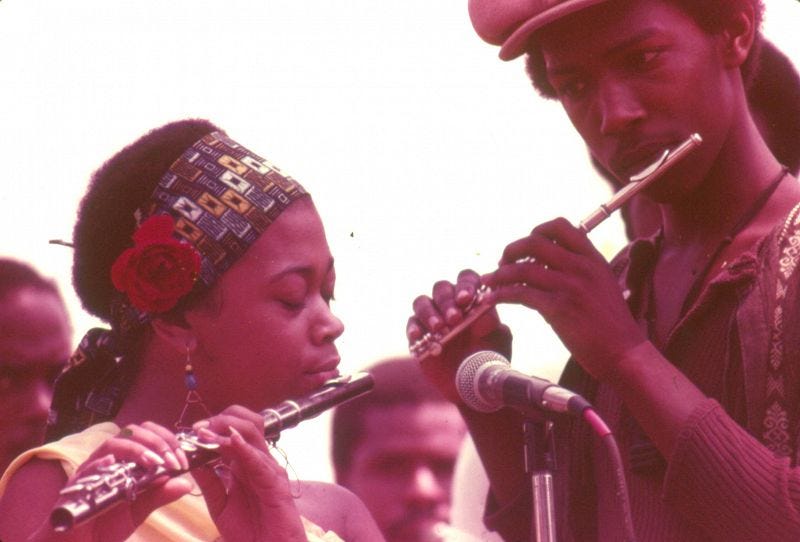
Maybe it’s a symptom of getting older, but my mind can no longer fathom 6 in the morning. Unless I need to hit the road early or meet a lingering deadline, the time passes without much thought, my phone flipped over on silent mode.
In rare moments when my alarm is set to go off then, I’m awakened by gorgeous sounds I don’t remember programming. It’s the song “Desert Fairy Princess” from the flutist Adele Sebastian’s album of the same name, a meditative track bolstered by polyrhythmic percussion, chanting, sprightly piano chords, and emotive strings. The track moves calmly, at times sauntering along the background, until sudden flourishes come and reset the already-sunlit arrangement, making it open, free-flowing, and brighter somehow. I once forgot that the song is nine minutes long and that I should get up and get the day started. What a way to begin, though.
The name Adele Sebastian likely doesn’t ring bells in broader jazz circles, but it should. During her lifetime, a tragically short span of 27 years due to kidney failure, she played flute alongside a number of prominent West Coast jazz musicians, and was a member of the pianist Horace Tapscott’s Pan Afrikan Peoples Arkestra, a community arts collective offering local jazz and music education to students across Los Angeles. In its heyday, the Arkestra would perform in prisons, hospitals and churches, but didn’t record its first studio album until the late 1970s. As a member of the Arkestra, one can hear Sebastian’s contributions quite strongly, soaring across the top of 1978’s “The Call,” or wafting through the middle of 1979’s “Noissessprahs.”
It’s not like the flute is the strongest instrument; in recent years, artists like Shabaka Hutchings and André 3000 have switched to it because of the serenity it induces. So for Sebastian to stand out, even as the other players got bigger sounds out of their instruments, she had to have a tone that was equally lush and piercing, something delicate enough to land softly and sharp enough to incite a tired author with a lot on his plate. And she did. Forty years after releasing her only album, Sebastian’s tone still captivates.
Adele Stephanie Sebastian was born August 14, 1956 in Riverside, California to a father, Malvin, who played saxophone, a mother, Jacquelyn, who played piano with the Albert McNeil Jubilee Singers, and brothers, Malvin Jr. and Joseph, who sang. With the flute as her foundational instrument, Sebastian decided to broaden her cultural worldview, majoring in Theatre Arts and minoring in Pan African Studies at California State University. That’s where she met Tapscott and started playing with the Arkestra, learning the ins and outs of his community-centered jazz while strengthening her chops as a flutist, composer and vocalist.
For Sebastian, a trained musician with an interest in Pan-Africanism, performing in the Arkestra married her love of art with her sense of Black pride. “I want to be an inspiration to all people,” she once said. “I strongly believe in, contribute to and support the preservation and education of the black arts. For these are my people and our contributions are priceless.” In 1973, Sebastian also co-wrote and choreographed a Black history musical called It’s A Brand New Day, which further showcased her affinity for Pan African art untethered to form or genre. These vast experiences coalesced on Desert Fairy Princess, her magnum opus.
Released in 1981, Desert Fairy Princess was a 38-minute spiritual jazz suite that brought her creative ambitions to the fore. Featuring Bobby West on piano; Daa'oud Woods on percussion; Billy Higgins on drums; Roberto Miranda on bass; and Rickey Kelley on marimba, the album conveys matters of the soul in ways that align with Sebastian’s personal constitution. These songs are heartwarming, her flute billowing amid the simmering hum of Higgins’ drum and West’s radiant piano. There’s a palpable joy emanating here; on arrangements like “Belize” and “I Felt Spirit,” Sebastian’s playing sounds light and effervescent, the sound of burgeoning youth with the world to gain. The same went for “Man From Tangayika,” her version of McCoy Tyner’s original. Where his track focuses on the piano as its lead instrument, Sebastian’s arrangement rightfully puts the flute center stage, the pace quickened to a mid-tempo mix of drum-heavy West African rhythm. Elsewhere, on “Day Dream,” it feels like Sebastian is reflecting on her past. Yet there’s no sorrow; instead, she can only smile when pondering freedom. “I’m looking back on my yesterdays,” goes a line from the track. “I’ve made brand new plans just to fit my ways.”
To that end, the concluding track, “Prayer For The People,” feels sad when reexamined now. On it, Sebastian asks her god if her music will make an impact within the grander vision of life. It’s mournful because, upon its release, Desert Fairy Princess didn’t make much noise beyond those who already knew about her and the Arkestra, as the album’s musical scope didn’t align with where jazz was headed at the time. Even the genre’s biggest stars had started to blend jazz with funk and R&B, so an LP like Princess — with its overt ties to traditional jazz and Afrocentrism — was bound to have a tougher time in the marketplace. “Will my music do anything for you?” she asks on the song. Sebastian passed just two years later.
There’s a remarkable sincerity to her work that resonates deeply with me. Because artists of all disciplines ask similar questions, whether they admit to it or not. Does my work land? Will it stick around? Does anyone care? It doesn’t seem Sebastian was overly preoccupied with such inquiries, but I also wonder if she received any flowers before she passed, or if her legacy is bound for reflective pieces like this one, and through occasional songs scattered across compilation albums. I can’t get past the omnipresence. Her music feels guided by it, that connection to the unknown, as if she knew her time was finite and all that’s left was the art. Forty years later, Desert Fairy Princess remains a major part of Sebastian’s heritage. Her star shone brightly and burned out too soon.